

India Used Car Market to Reach USD 136.93 Billion by 2035, Growing at 13.50% CAGR
India Used Car Market
North India generated 38.6% of revenue in the India Used Car Market, led by Delhi-NCR's dense dealer network.
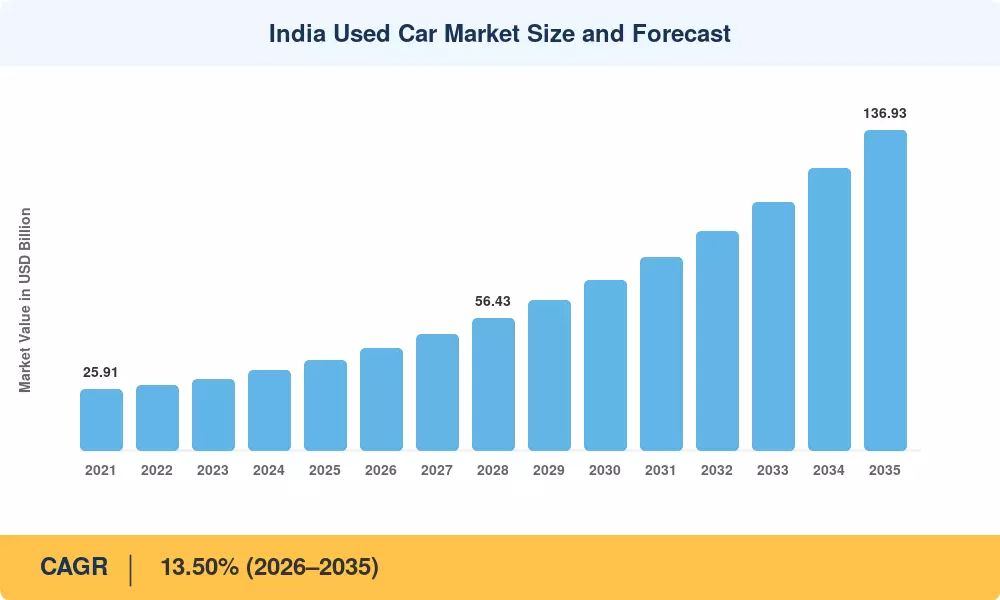
NEW YORK, NY, UNITED STATES, August 31, 2026 /EINPresswire.com/ -- According to Market Research Future, the India Used Car Market is projected to expand from USD 43.81 billion in 2026 to USD 136.93 billion by 2035, registering a CAGR of 13.50% across the forecast period, driven by Growing demand for electric vehicles creates opportunities in the India used car market. This extraordinary growth reflects the structural transformation of India's automotive landscape, where used cars are increasingly becoming the primary gateway to vehicle ownership for millions of aspiring buyers, reshaping the nation's mobility story.Market Overview
India's used car market is experiencing a fundamental transition from an informal, price-led space to a far more structured and trust-oriented mobility ecosystem . Currently the world's fifth-largest used car market, India is projected to become the third-largest by the end of the decade, trailing only the United States and China in volume and value . The market is estimated to be 1.39 times the size of the new-car market and is growing at 11-13% annually, with the organised segment expanding at more than 20% per year . With annual sales projected to reach 9-10 million units by FY2031, up from approximately 6 million units in FY2026, the used car market is emerging as the dominant gateway to vehicle ownership for millions of Indians .
The key growth drivers propelling this market expansion include rising disposable incomes and an expanding addressable buyer base, with India having crossed the USD 2,000 per capita income threshold—widely regarded as an inflection point for discretionary spending . Structural shifts in ownership patterns, with replacement cycles shortening from 7–8 years to an expected 4–5 years by FY2031, are increasing the supply of newer vehicles into the resale ecosystem . The growing penetration of financing, which has doubled from approximately 16% to 32% over the past five years, is making used cars more accessible to first-time buyers . The shift in consumer mindset from viewing used cars as a compromise purchase to a financially practical alternative for value optimisation is driving sustained demand .
Technological developments are reshaping the used car landscape at an accelerating pace. Digital platforms are playing a transformative role, with India projected to have up to 900 million digital transactors by FY2031, enabling improved discovery, price transparency, and transaction efficiency . Features such as real-time pricing benchmarks, online documentation, and integrated financing are reducing friction and improving the customer experience . AI is playing a pivotal role in this evolution, with AI-led searches rising 6.7 times year-on-year, while searches related to buying cars grew 7.2 times . Organised, full-stack platforms offering end-to-end solutions—including certified inventory, financing, warranties, and seamless documentation—are emerging as potential solutions to bridge the longstanding trust gap . The Used Cars Market continues to evolve globally, while the India Automotive Retail Market reflects broader transformation across the automotive sales ecosystem.
📍 Get Free Sample Report for Detailed Market Insights:
https://www.marketresearchfuture.com/sample_request/21553
Market Segmentation
The India used car market is segmented based on vehicle type, vendor type, fuel type, vehicle age, price band, transmission, and ownership count to provide comprehensive insights into the industry landscape.
By Vehicle Type: The market is categorized into Micro/Hatchback, Sedan, SUV, and MPV/MUV segments. Micro/hatchbacks command a dominant 52-60% of total sales, reflecting their role as entry-level mobility solutions . SUVs have grown to 32% of total sales, demonstrating the fastest growth at 15.95% CAGR, driven by value retention perceptions and aspirational demand . Sedans have slipped to 16% as consumers migrate toward SUVs, with traditional three-box designs losing appeal among younger buyers . The shift toward SUVs is expected to increase the average selling price from approximately Rs 5 lakh currently to Rs 6.5-6.9 lakh by FY2031 . Metro buyers lean toward SUVs and premium hatchbacks, while non-metro buyers prioritise hatchbacks and compact sedans for their reliability and low running costs .
By Vendor Type: The market is segmented into Unorganised Local Dealers, OEM-Certified Franchise, Online Platforms, and Peer-to-Peer channels. Unorganised local dealers maintain a dominant 70-80% market share, reflecting the market's fragmented nature . However, organised players are gaining share, with marketplace and inventory-led platforms now accounting for approximately 26% of the market, up from 20-21% in FY2022 . Online platforms are achieving the fastest growth at 26.85% CAGR, driven by transparency initiatives and financing integration . Organised players are projected to capture nearly 30% of the market by FY2031, with full-stack platforms expected to reach 5-6% market share and approximately USD 4 billion in GMV .
By Fuel Type: The market covers Petrol, Diesel, CNG/LPG, and Battery-Electric segments. Petrol dominates with approximately 85% share of used car sales, benefiting from widespread refueling infrastructure and consumer familiarity . Diesel faces declining preference due to emission norms, though maintaining appeal in commercial applications. Battery-electric vehicles demonstrate an exceptional 34.10% CAGR from a low base, driven by growing EV adoption in the new car market . However, the used EV segment faces significant headwinds from resale value concerns, with 51% of EV owners considering switching to ICE vehicles due to charging anxiety, maintenance costs, and lack of predictable resale benchmarks . Unlike internal combustion vehicles, electric vehicles currently lack predictable resale benchmarks due to rapid technological evolution and concerns around battery health, presenting both a challenge and an opportunity for organised players to establish credible EV resale frameworks .
By Vehicle Age: The market serves Less Than 3 Years, 3–5 Years, 5–8 Years, and More Than 8 Years segments. The average age of used cars sold has declined to approximately four years from more than eight years a decade ago, driven by faster model refresh cycles and shorter ownership periods . Vehicles aged 3-5 years offer the optimal balance between affordability and reliability, making them the most actively traded segment.
By Price Band: The market is segmented into Below INR 3 Lakh, INR 3–5 Lakh, INR 5–8 Lakh, INR 8–12 Lakh, and More Than INR 12 Lakh categories, accommodating diverse buyer profiles from first-time owners to premium aspirational buyers.
By Transmission: The market serves Manual and Automatic segments, with automatics now accounting for 37% of transactions, reflecting growing preference for convenience and urban drivability .
By Ownership Count: The market is segmented by First-Owner, Second-Owner, and Third-Owner & Beyond categories.
🛒 You can buy this market report at:
https://www.marketresearchfuture.com/checkout?currency=one_user-USD&report_id=21553
Regional Analysis
South India has emerged as the country's largest used car market, accounting for approximately 41.5% of total transactions in 2025 . Karnataka alone contributed 16.5% of national demand, followed by Tamil Nadu at 12%, Telangana at 10.1%, and Kerala at 2.9% . More than four out of every ten used cars sold in India in 2025 were transacted in South India alone, with Tamil Nadu leading on average selling price at Rs 5.49 lakh, supported by strong mid-to-premium demand .
West India follows closely, accounting for roughly 34.2% of used car demand in 2025 . Maharashtra emerged as the single largest state contributor, accounting for 20.7% of total national used car demand, growing from 16.4% in 2024 . Gujarat added another 13.5%, placing it among the top three states nationally . More than one-third of all used car transactions in India originated from western states .
North India accounts for approximately 24.8% of used car demand when key northern states are combined . Uttar Pradesh contributed 13%, Delhi 6%, and Haryana 5.8% . Notably, Delhi's share of national sales dropped sharply from 13.8% in 2024 to 5.8% in 2025, while Haryana fell from 10.7% to 5.6%, representing a structural rebalancing of demand away from northern metros toward western and southern states .
East India contributes a smaller but steady share, with West Bengal accounting for approximately 2.5% of total used car demand . While scale remains limited relative to other regions, transactions have remained stable, making it a consistent part of the national used car ecosystem.
Tier-2 Cities now account for 62% of used car purchases, underscoring rising purchasing power and aspiration in non-metro India . The centre of gravity has shifted away from major metros, bringing with it a fundamentally different kind of buyer with distinct priorities, budgets, and expectations of car ownership . Metro and non-metro buyers represent genuinely distinct demand profiles shaped by different income levels, road conditions, and expectations.
Competitive Landscape and Key Players
The India used car market is characterised by a highly fragmented competitive landscape with unorganised players dominating, while organised players steadily gain share through technology, standardisation, and trust-building.
Key players operating in this market include Cars24, Spinny, CarTrade, Maruti Suzuki True Value, Mahindra First Choice, Hyundai H Promise, Toyota U Trust, and various digital platforms and OEM-certified franchises. Unorganised local dealers maintain a dominant position, with approximately 50,000 dealers typically selling 4-6 vehicles per month with limited inspection and refurbishment processes .
Strategic developments are reshaping the competitive landscape. Asset-light marketplace platforms account for approximately 85% of organised transactions, while inventory-led players make up the remainder . Marketplace operators achieved profitability last fiscal, whereas inventory-led businesses are reducing losses through tighter cost management . Organised players raised approximately Rs 3,000 crore over the past two years, indicating significant capital investment in technology infrastructure and customer acquisition . Full-stack players offering end-to-end services across sourcing, refurbishment, pricing, sales, and financing are expected to capture 5-6% market share by FY2031 .
Innovation and technology initiatives are accelerating across the industry. Digital platforms are investing heavily in AI-powered valuation tools, real-time pricing benchmarks, and integrated financing solutions . Companies are developing standardised inspection protocols, certified inventory programs, and warranty offerings to address the trust deficit in the used car space . The market is moving toward "NVH by design" approaches where technology integration and trust-building are becoming key differentiators. The boundaries between traditional classifieds, full-stack platforms, and OEM-certified programs are blurring as companies seek comprehensive, technology-driven solutions addressing the complete lifecycle needs of used car buyers and sellers.
Market Challenges and Opportunities
The India used car market faces several key challenges that could impact growth trajectories. Trust deficits and structural inefficiencies continue to constrain full potential, with only approximately 40% of buyers actively recommending their purchase experience . Information asymmetry remains the primary barrier to market expansion, with quality assessment challenges particularly acute in the unorganised segment . Buyers face issues such as limited transparency, poor vehicle quality checks, lack of warranties, and cumbersome paperwork processes . Sellers face difficulties in price discovery, securing timely payments, and completing ownership transfers, while unorganised dealers operate under constraints such as limited access to capital, fragmented sourcing, and operational inefficiencies . Unorganised local dealers, despite their dominance, lack standardisation, limiting their ability to scale and compete effectively .
Emerging opportunities are abundant in the evolving automotive landscape. The used-to-new car ratio remains below the 2.5-3.5 times seen in mature markets, indicating significant headroom for growth . Organised, full-stack platforms addressing structural inefficiencies could unlock a 15-20% compound annual growth rate, potentially adding 3-5 million additional used-car transactions by FY2031 . Improved access to financing is a key enabler, with used-car loan penetration expected to rise to 30-40% by FY2027, driven largely by NBFC participation . Government-led reforms—including vehicle scrappage policies, digitised registration systems, and e-KYC frameworks—are further formalising the market and improving transparency . The growing demand for electric vehicles, while currently facing resale value headwinds, presents opportunities for organised platforms to establish credible EV resale frameworks, inspection protocols, and battery health certification programs. As over 90% of India's car base is likely to remain non-electric over the next decade, the market for ICE vehicles remains robust .
To explore more market insights, visit us at:
https://www.marketresearchfuture.com/reports/india-used-car-market-21553
Final Market Summary
The India used car market is poised for extraordinary growth, driven by rising incomes, shorter replacement cycles, improving financing access, and the accelerating formalisation of the automotive retail ecosystem. The market's trajectory from USD 43.81 billion in 2026 to USD 136.93 billion by 2035 reflects the fundamental transformation of India's mobility landscape, where used cars are increasingly becoming the preferred pathway to vehicle ownership.
The long-term industry potential remains exceptionally bright, with technological innovation, digital adoption, and government reforms continuing to expand the addressable market. The convergence of used cars with broader mobility ecosystems, including electric vehicles, shared mobility platforms, and digital financing, is creating comprehensive solutions that serve diverse customer needs across metro and non-metro India.
Key factors expected to influence future development include the pace of organised sector expansion, the evolution of financing penetration, and the establishment of credible resale benchmarks for electric vehicles. The development of trust-driven, technology-enabled platforms offering inspection, refurbishment, financing, and warranty support will accelerate formalisation and address structural inefficiencies. As consumer preferences shift toward value optimisation and assured quality, the used car market is well positioned to establish itself as a central pillar of India's personal mobility landscape, ensuring sustained innovation and growth throughout the forecast period and beyond.
More Related Reports from MRFR Library:
Micro Mobility Market : https://www.marketresearchfuture.com/reports/micro-mobility-market-8315
Car Wash Machine Market : https://www.marketresearchfuture.com/reports/car-wash-machine-market-9600
Green Sustainable Tourism Market : https://www.marketresearchfuture.com/reports/green-sustainable-tourism-market-12014
Shared Mobility Market : https://www.marketresearchfuture.com/reports/shared-mobility-market-12401
India Automotive Industry Market : https://www.marketresearchfuture.com/reports/india-automotive-industry-market-12546
US Automotive Industry : https://www.marketresearchfuture.com/reports/us-automotive-industry-market-12674
China Automotive Industry Market : https://www.marketresearchfuture.com/reports/china-automotive-industry-market-12675
Car Accessories Market : https://www.marketresearchfuture.com/reports/car-accessories-market-12704
Software Defined Vehicle Market : https://www.marketresearchfuture.com/reports/software-defined-vehicle-market-13918
Railway Signaling System Market : https://www.marketresearchfuture.com/reports/railway-signaling-system-market-13919
Market Research Future
Market Research Future
+1 855-661-4441
email us here
Legal Disclaimer:
EIN Presswire provides this news content "as is" without warranty of any kind. We do not accept any responsibility or liability for the accuracy, content, images, videos, licenses, completeness, legality, or reliability of the information contained in this article. If you have any complaints or copyright issues related to this article, kindly contact the author above.
