

Get your business and economy news from the world
Provided by AGP
Save your energy: how the war in the Middle East could affect household savings and the economy
Prepared by Niccolò Battistini, Alina Bobasu, Rodolfo Dinis Rigato and Hanno Kase
Rising energy prices and heightened consumer uncertainty related to the war in the Middle East have renewed risks to the outlook for the household saving rate. After declining from its post-pandemic peak, the saving rate increased rapidly in 2022 and 2023 and has remained elevated since 2024, standing above its highest pre-pandemic level (Chart A). This has largely been on account of strong real income growth and subdued domestic demand amid declining real energy prices and uncertainty after the previously high levels triggered by Russia’s invasion of Ukraine. However, as the economic repercussions of the war in the Middle East unfold, recent trends in energy prices and uncertainty may reverse, with implications for the saving rate. Against this backdrop, this box assesses how alternative paths for the terms of trade (closely tracking real energy prices) and for consumer uncertainty could affect the saving rate, as well as their distributional and macroeconomic consequences.
Chart A
Saving rate, real energy prices and consumer uncertainty
(changes since the fourth quarter of 2021, percentages and percentage points)
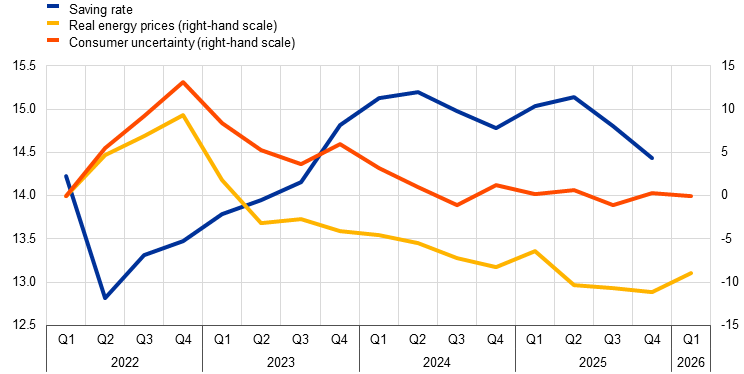
Sources: Eurostat, European Commission Business and Consumer Survey and ECB staff calculations.
Notes: Real energy prices are measured as the ratio of the energy component of the Harmonised Index of Consumer Prices (HICP) to overall HICP. The latest observations are for the fourth quarter of 2025 for the saving rate and the first quarter of 2026 for real energy prices and consumer uncertainty.
Adverse dynamics in the terms of trade and consumer uncertainty typically have opposite effects on the household saving rate in the short term. In a net energy importing economy, such as the euro area, the terms of trade – proxied by the ratio of the GDP deflator to the consumption deflator – typically decline when energy prices increase.[1] Hence, lower terms of trade typically reflect losses in the real disposable income of households both directly, through higher prices for imported energy products, and indirectly, through lower real wages and profits distributed by firms.[2] These real income losses tend to translate into lower spending and, to a larger extent, lower savings, as shown by the positive relationship between the terms of trade and the saving rate (Chart B, panel a). By contrast, higher consumer uncertainty – often triggered by the same underlying shock, such as energy price increases – strengthens precautionary motives, dampening consumption and raising the saving rate, as illustrated by the positive correlation between uncertainty and the saving rate (Chart B, panel b). During the pandemic period, the saving rate was particularly sensitive to changes in the terms of trade and consumer uncertainty. However these strong elasticities were most likely amplified by households’ responses to restrictions on mobility and have normalised since the pandemic.[3]
Chart B
Saving rate, terms of trade and consumer uncertainty
(x-axis: year-on-year changes, percentages and percentage points; y-axis: year-on-year changes, percentage points)
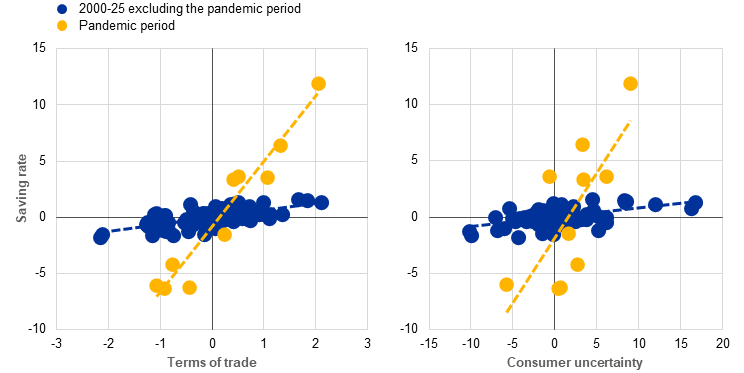
Sources: Eurostat, European Commission Business and Consumer Survey and ECB staff calculations.
Notes: In panel a), the terms of trade are proxied by the ratio of the GDP deflator to the private consumption deflator. In panel b), consumer uncertainty is leading by four quarters, broadly in line with the peak impact of consumer uncertainty shocks on the saving rate in the empirical model described below. “Pandemic period” refers to the period between the first quarter of 2020 and the second quarter of 2023.
An empirical model is used to estimate the effects of large shocks to the terms of trade and consumer uncertainty on the saving rate. A Bayesian structural vector autoregression model is estimated using euro area data from the first quarter of 1999 to the fourth quarter of 2025.[4] It quantifies the role of unexpected changes in the terms of trade and consumer uncertainty, as well as shocks to domestic demand, domestic income and the interest rate.[5] To assess the impact of adverse developments in the terms of trade and consumer uncertainty, two scenarios for the saving rate based on the estimated model elasticities are considered (Chart C). First, an adverse terms-of-trade shock of a magnitude comparable to the deterioration observed during 2022 would lower the saving rate by 0.3 percentage points at its trough at the beginning of 2027. Second, a rise in uncertainty broadly consistent with that observed at the onset of Russia’s invasion of Ukraine would raise the saving rate by 0.4 percentage points at its peak at the end of 2027.
Chart C
Alternative paths for the saving rate following large shocks to the terms of trade and consumer uncertainty
(deviations from baseline, percentage points)
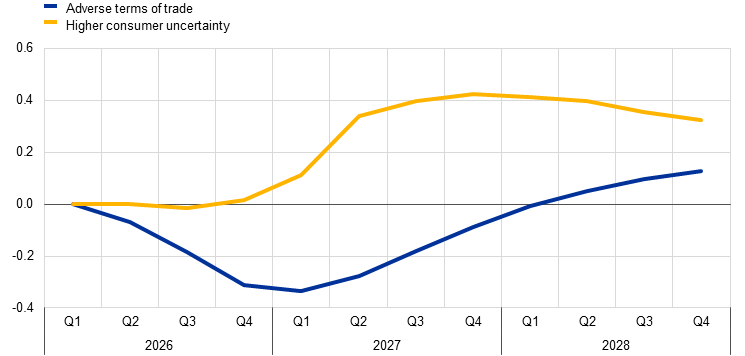
Sources: Eurostat, European Commission Business and Consumer Survey and ECB staff calculations.
Note: The paths are computed using the model-implied elasticities of the saving rate to shocks in the terms of trade and consumer uncertainty.
Two macroeconomic models are used to assess the implications of alternative paths for the saving rate in response to adverse shocks to the terms of trade and consumer uncertainty. The aggregate macroeconomic effects are evaluated using ECB-BASE (Angelini et al., 2019), a semi-structural model for the euro area. Moreover, terms-of-trade shocks, especially when related to energy prices, may have strong redistributive effects.[6] When faced with higher prices for imported goods, high-income households may be able to smooth their consumption by drawing down savings, while low-income households may have to reduce their consumption more significantly. These distributional effects are assessed using an open economy extension of Kase and Rigato (2025), a Heterogeneous-Agent New Keynesian (HANK) model augmented with trade and energy imports. In the ECB-BASE model, structural shocks are calibrated to target the saving rate paths shown in Chart C, i.e. as an energy price shock for the terms-of-trade scenario and a direct shock to consumption expenditure for the consumer uncertainty scenario. In the HANK model, a standardised one percentage point change in the saving rate is simulated to quantify the distributional impact of changes in household savings generated by each shock.
The ECB-BASE model shows that adverse shocks to the terms of trade and consumer uncertainty would weigh on real GDP growth while having opposite effects on HICP inflation (Chart D). A deterioration in the terms of trade erodes real income, as imported energy prices rise while nominal wages adjust slowly, weighing on consumption. This increases inflation by 0.4 percentage points – driven almost entirely by the energy component – and reduces growth by 0.1 percentage points in 2027. These effects partly revert in 2028. By contrast, higher consumer uncertainty strengthens precautionary behaviour and reduces household demand. This implies a reduction in growth of 0.3 percentage points in 2027, with negligible effects on inflation.
Chart D
Effects on real GDP growth and HICP inflation
(deviations from baseline, percentage points)
a) Real GDP growth |
b) HICP inflation |
|---|---|
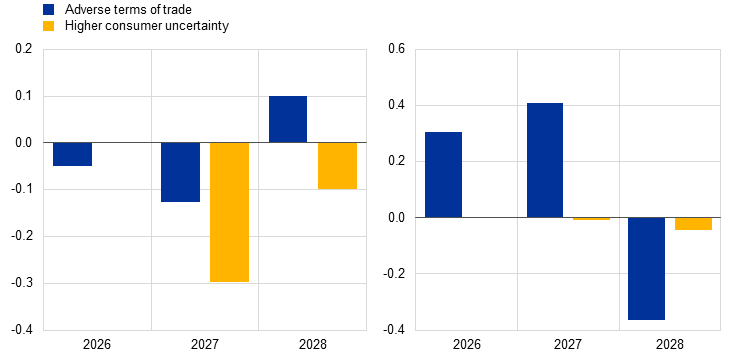 | |
Source: ECB staff calculations based on ECB-Base simulations.
Notes: The “higher consumer uncertainty” scenario is modelled as a shock to consumption and the “adverse terms-of-trade” scenario as an imported energy price shock. All simulations assume exogenous monetary policy.
The HANK model suggests that adverse terms-of-trade shocks are regressive, with low-income households experiencing a larger decline in consumption, while shocks affecting consumer uncertainty have opposite effects (Chart E). Following an adverse terms-of-trade shock, households in the lowest income tercile account for more than half (54%) of the decline in consumption, above their model-implied steady-state consumption share (18%), as they lack large liquidity buffers to cushion losses in real labour income. By contrast, an increase in consumer uncertainty places most of the decline in consumption (63%) with households in the top tercile, reflecting their higher baseline share in total consumption (52%). Turning to savings, households in the top tercile account for the largest adjustments following both shocks, consistent with their larger asset holdings.
Chart E
Distributional effects on consumption by income tercile
(percentages)
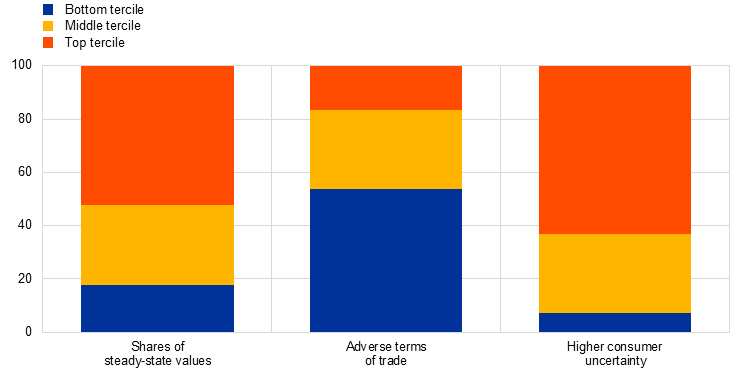
Source: ECB staff calculations based on HANK model simulations.
Notes: The column on the left displays the share of each income tercile in aggregate steady-state consumption. The columns in the middle and on the right show the contribution of different income terciles to the cumulative variation in consumption following each shock.
Simultaneous shocks to the terms of trade and consumer uncertainty, as key drivers of the household saving rate, pose significant risks to growth and inflation. Shocks to the terms of trade and consumer uncertainty affect the saving rate in opposite directions, at least in the short term. If these shocks were to materialise simultaneously in reaction to heightened geopolitical tensions linked to the war in the Middle East, they could reinforce each other through their broader effects on domestic demand, income and energy costs. In such a situation, the combined effect of these shocks could exert a sizeable drag on growth, even with a broadly stable saving rate. While the terms of trade and consumer uncertainty channels have opposite effects on inflation, their net impact would be upward pressure on inflation.
References
Angelini, E., Bokan, N., Christoffel, K., Ciccarelli, M. and Zimic, S. (2019), “Introducing ECB-BASE: The blueprint of the new ECB semi-structural model for the euro area”, Working Paper Series, No 2315, ECB, September.
Auclert, A., Rognlie, M., Souchier, M. and Straub, L. (2024a), “Exchange Rates and Monetary Policy with Heterogeneous Agents: Sizing up the Real Income Channel”, NBER Working Paper, No 28872, National Bureau of Economic Research, August.
Auclert, A., Monnery, H., Rognlie, M. and Straub, L. (2024b), “Managing an energy shock: fiscal and monetary policy”, in Bauducco. S., Fernández, A. and Violante, G.L. (eds.), Heterogeneity in Macroeconomics: Implications for Monetary Policy, Central Bank of Chile, Santiago, pp. 39-108.
Battistini, N., Di Nino, V., Dossche, M. and Kolndrekaj, A. (2022), “Energy prices and private consumption: what are the channels?”, Economic Bulletin, Issue 3, ECB.
Battistini, N., Bobasu, A. and Gareis, J. (2023), “Who foots the bill? The uneven impact of the recent energy price shock”, Economic Bulletin, Issue 2, ECB.
Bobasu, A., Di Nino, V. and Osbat, C. (2023), “The impact of the recent inflation surge across households”, Economic Bulletin, Issue 3, ECB.
Bobasu, A., Dobrew, M. and Repele, A. (2025), “Energy price shocks, monetary policy and inequality”, European Economic Review, Vol. 175, Article 104986.
Bokan, N., Dossche, M. and Rossi, L. (2018), “Oil prices, the terms of trade and private consumption”, Economic Bulletin, Issue 6, ECB.
Dossche, M., Krustev, G. and Zlatanos, S. (2021), “COVID-19 and the increase in household savings: an update”, Economic Bulletin, Issue 5, ECB.
Kase, H. and Dinis Rigato, R. (2025), “Beyond averages: heterogeneous effects of monetary policy in a HANK model for the euro area”, Working Paper Series, No 3086, ECB, August.
Legal Disclaimer:
EIN Presswire provides this news content "as is" without warranty of any kind. We do not accept any responsibility or liability for the accuracy, content, images, videos, licenses, completeness, legality, or reliability of the information contained in this article. If you have any complaints or copyright issues related to this article, kindly contact the author above.
