

Global Ethylene Bis Stearamide (EBS) Market Led by North America; BASF, Croda, PMC Biogenix Compete
Ethylene Bis Stearamide (EBS)
Ethylene Bis Stearamide EBS Market is segmented by Form (Powder, Bead/Flake, and Granule), Application (Lubricant & Mold Release, Dispersant, and Anti-block)
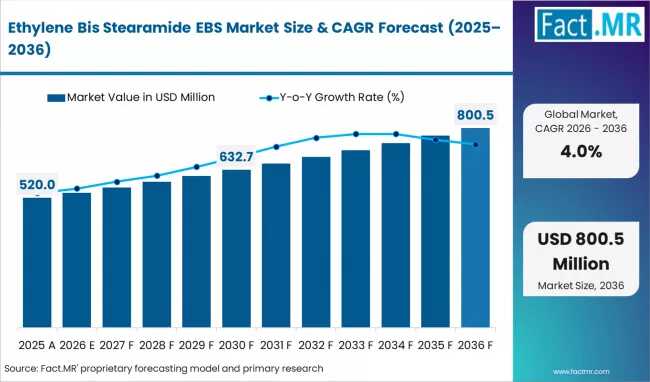
ROCKVILLE, MD, UNITED STATES, April 9, 2026 /EINPresswire.com/ -- According to Fact.MR’s latest analysis, the global ethylene bis stearamide (EBS) market is undergoing steady transformation driven by rising polymer processing volumes, tighter quality specifications, and expanding applications across plastics, rubber, and coatings industries.The market is valued at USD 540.8 million in 2026 and is projected to reach USD 800.52 million by 2036, expanding at a CAGR of 4.0%. The market stood at USD 520.0 million in 2025, highlighting stable demand momentum.
The industry is expected to create an incremental opportunity of USD 259.72 million over the forecast period. Market transformation is fueled by increasing demand for processing efficiency, surface quality improvements, and friction reduction in polymer manufacturing. As downstream industries demand consistent dispersion, lubrication, and mold release performance, EBS is becoming a specification-driven additive rather than a commodity input.
Get detailed market forecasts, competitive benchmarking, and pricing trends:
https://www.factmr.com/connectus/sample?flag=S&rep_id=5952
Quick Stats
Market Size (2026): USD 540.8 Million
Market Size (2027 est.): ~USD 562 Million
Forecast Value (2036): USD 800.52 Million
CAGR (2026–2036): 4.0%
Incremental Opportunity: USD 259.72 Million
Leading Segment: Powder Form (64% share)
Leading Region: North America
Key Players: BASF, Croda, PMC Biogenix, Chukyo Yushi, Nippon Fine Chemical
Executive Insight for Decision Makers
The market is shifting from cost-driven procurement to performance-driven specification sourcing.
OEMs and compounders must prioritize consistent particle size distribution and melting stability.
Manufacturers should invest in process control and feedstock supply diversification.
Investors should focus on high-margin micronized and specialty grades.
Companies failing to adopt advanced formulations risk losing contracts in high-speed extrusion and injection molding applications.
Market Dynamics
Key Growth Drivers
Expansion of global polymer manufacturing capacity
Rising demand for high-quality surface finish in plastics
Increasing use in packaging films as anti-blocking agent
Growth in automotive lightweight plastics applications
Key Restraints
Raw material price volatility (stearic acid, ethylenediamine)
Availability of alternative processing aids
Environmental regulations impacting chemical additives
Emerging Trends
Bio-based and eco-friendly EBS formulations
Micronized EBS for coatings and specialty plastics
Integration in high-performance engineering polymers
Growth of customized dispersant-grade EBS
Segment Analysis
Leading Segment: Powder Form – 64% Share
Powder form dominates due to superior dispersion, ease of blending, and compatibility across polymer matrices.
Fastest-Growing Segment: Granular and micronized specialty grades driven by precision processing applications.
By Application
Lubricant & Mold Release – 47% share
Dispersant applications
Anti-blocking agents in films
By End Use
Plastics Processing – 61% share
Rubber Compounding
Coatings and Paints
Strategic Importance:
Plastics processors increasingly depend on EBS for processing stability and reduced cycle times, making it critical for operational efficiency.
Supply Chain Analysis
Raw Material Suppliers
Stearic acid producers
Ethylenediamine manufacturers
Fatty acid chemical suppliers
Manufacturers / Producers
Specialty chemical companies producing EBS via condensation reactions
Integrated oleochemical producers
Distributors
Chemical distributors
Polymer additive suppliers
Regional specialty chemical traders
End-Users
Plastics compounders (largest buyers)
Packaging film manufacturers
Rubber processors
Coatings formulators
Who Supplies Whom
Oleochemical suppliers → EBS producers
EBS producers → polymer compounders & additive distributors
Distributors → SMEs & regional processors
Compounders → automotive, packaging, construction industries
Pricing Trends
Commodity-grade EBS competes on volume-based pricing
Micronized and specialty grades command premium margins
Pricing influenced by:
Stearic acid cost fluctuations
Petrochemical feedstock trends
Particle size requirements
Regulatory compliance standards
Typical margin range: 12–22% depending on grade complexity
Regional Analysis
Top Countries by CAGR
USA – 4.6%
Mexico – 4.3%
Germany – 3.8%
France – 3.6%
UK – 3.3%
Regional Insights
North America: Strong polymer manufacturing base
Europe: Focus on high-performance specialty grades
Asia-Pacific: Rapid plastics production expansion
Latin America: Growing packaging industry demand
Japan & Korea: Specialty coatings and electronics polymers
Developed vs Emerging Markets
Developed markets demand high-purity grades
Emerging markets prioritize cost-effective processing aids
Competitive Landscape
The market remains moderately fragmented with specialty chemical players dominating.
Key Players
BASF
Croda
PMC Biogenix
Chukyo Yushi
Nippon Fine Chemical
DEUREX
KLK Oleo
Kao Chemicals
Sinwon Chemical
Fuchi Pharm
Competitive Strategies
Product innovation
Micronized grade development
Global distribution expansion
Technical support services
Cost optimization via feedstock integration
Strategic Takeaways
For Manufacturers
Invest in micronized specialty EBS grades
Strengthen feedstock procurement strategy
For Investors
Focus on companies serving packaging and automotive sectors
Target Asia-Pacific expansion opportunities
For Marketers / Distributors
Offer technical support and formulation guidance
Build relationships with polymer compounders
Future Outlook
The market is expected to shift toward high-performance specialty additives. Sustainability initiatives will push development of bio-based fatty amide waxes. Advanced manufacturing techniques and engineering plastics will expand EBS applications in electronics and automotive lightweighting.
Long-term opportunity lies in precision processing additives and customized formulation solutions.
Conclusion
The global ethylene bis stearamide (EBS) market is transitioning from a conventional processing aid segment into a specification-driven specialty chemicals category. Companies investing in quality consistency, advanced formulations, and supply chain resilience will capture emerging opportunities. With steady polymer demand and increasing manufacturing complexity, EBS will remain a critical additive enabling efficiency, product quality, and cost optimization across industries.
Why This Market Matters
Ethylene bis stearamide is essential for improving polymer processing efficiency, reducing energy consumption, and enhancing product quality. As global manufacturing scales, EBS plays a crucial role in supporting sustainable, high-performance materials production, making it strategically important for chemical producers, polymer manufacturers, and investors.
Full Report: Unlock 360° insights for strategic decision making and investment planning-
https://www.factmr.com/checkout/5952
To View Related Report:
Ethylene Diamine Tetraacetic Acid (EDTA) Market https://www.factmr.com/report/ethylene-diamine-tetraacetic-acid-market
Ethylene Propylene Diene Monomer Market https://www.factmr.com/report/4947/epdm-market
Ethylene Vinyl Acetate Market https://www.factmr.com/report/ethylene-vinyl-acetate-market
Ethylene Dichloride Market https://www.factmr.com/report/ethylene-dichloride-market
S. N. Jha
Fact.MR
+1 628-251-1583
email us here
Legal Disclaimer:
EIN Presswire provides this news content "as is" without warranty of any kind. We do not accept any responsibility or liability for the accuracy, content, images, videos, licenses, completeness, legality, or reliability of the information contained in this article. If you have any complaints or copyright issues related to this article, kindly contact the author above.
