

Polymerase Chain Reaction Market to Reach US$31.3Bn by 2033 | Persistence Market Research
Polymerase Chain Reaction Market
The global polymerase chain reaction market is growing, driven by advances in technology, precision medicine, and increased demand for molecular diagnostics.
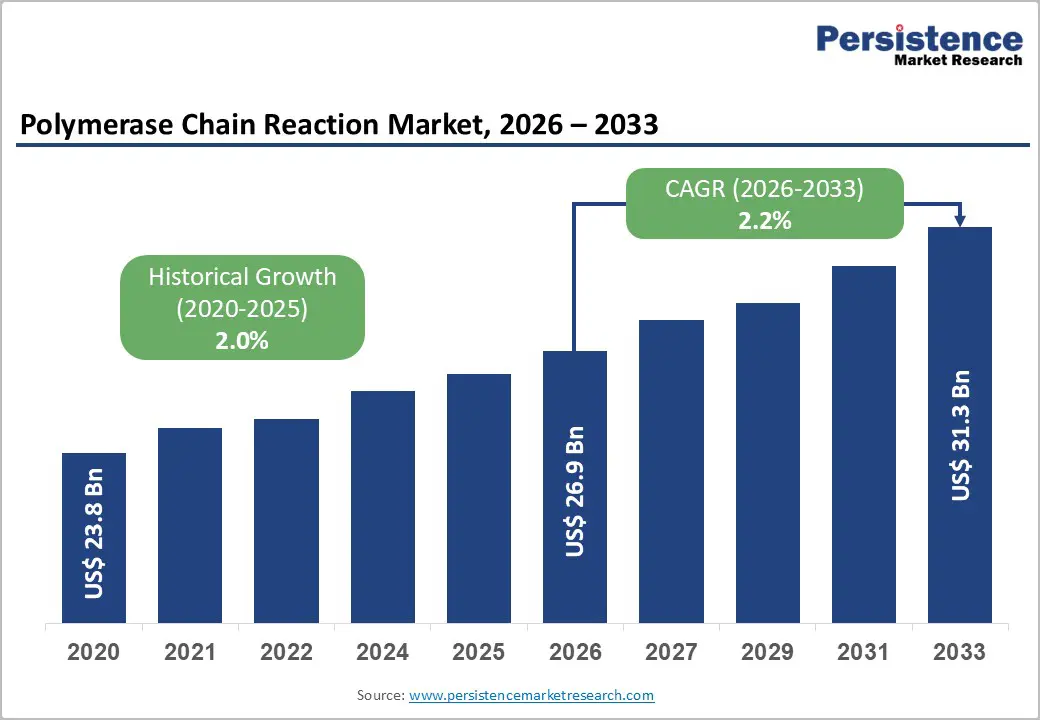
LONDON, UNITED KINGDOM, January 19, 2026 /EINPresswire.com/ -- The global polymerase chain reaction (PCR) market, integral to molecular diagnostics and life sciences, is on a growth trajectory, estimated to expand from US$26.9 billion in 2026 to US$31.3 billion by 2033, reflecting a Compound Annual Growth Rate (CAGR) of 2.2% during the forecast period. PCR, a key tool in amplifying DNA and RNA sequences, plays a critical role across a variety of sectors, including disease detection, genetic testing, forensic analysis, and research. The technology's contribution to diagnostic applications in oncology, infectious diseases, and personalized medicine ensures its enduring relevance, driving ongoing market growth.
Download Your Free Sample & Explore Key Insights: https://www.persistencemarketresearch.com/samples/33241
Key Drivers of Market Growth
Several key factors underpin the sustained expansion of the PCR market. Rising global healthcare needs, especially in the diagnostics sector, continue to drive demand for PCR technology. PCR's ability to offer rapid and accurate results in detecting viral and bacterial infections has made it a cornerstone of clinical diagnostics, particularly in high-demand areas such as oncology, genetics, and infectious diseases.
The growing popularity of real-time and digital PCR technologies has bolstered PCR's adoption in clinical settings, due to their enhanced sensitivity, quick turnaround times, and ability to deliver quantitative data, critical in personalized medicine. In parallel, advancements in multiplex PCR and automation technologies continue to improve efficiency and broaden the scope of PCR applications in both research and clinical laboratories.
Market Segmentation
The PCR market can be segmented by product type, application, and region. Among the key product categories, the Reagents and Consumables segment holds the largest share due to the recurring nature of PCR testing. These materials, such as DNA/RNA primers, probes, and enzymes, are essential for accurate amplification, forming the backbone of PCR testing in both clinical and research settings. Unlike PCR instruments, which are typically capital investments, reagents and consumables are used with every test, resulting in steady demand and recurrent revenue streams for manufacturers.
In terms of application, Clinical Diagnostics remains the dominant segment. PCR's central role in diagnosing infectious diseases, cancer biomarkers, and genetic disorders ensures its pivotal place in patient care. The ongoing integration of molecular diagnostics into routine clinical workflows amplifies demand for PCR systems, particularly in hospitals, diagnostic laboratories, and public health facilities. The COVID-19 pandemic has served as a prime example of how PCR technology can be rapidly deployed for large-scale diagnostics, cementing its place in global healthcare systems.
Challenges: Cold-Chain Logistics for Reagents
Despite its widespread use, the PCR market faces operational challenges, particularly related to the high dependence on cold-chain logistics for reagent storage and transportation. Many PCR reagents, including enzymes and master mixes, require strict temperature control (between –20°C and 8°C) during production, transportation, and storage. Maintaining the cold chain adds significant complexity and cost, particularly in regions with limited infrastructure or where reliable electricity is scarce.
This logistical barrier can lead to reagent wastage, compromised assay results, and delays in testing, particularly in remote or rural areas. As a result, smaller diagnostic laboratories and facilities in emerging markets are often faced with higher operational costs, which can limit access to PCR technology in these regions. Furthermore, during emergency situations or decentralized testing scenarios, the need for cold-storage infrastructure can hinder PCR's scalability compared to alternative molecular technologies with more flexible storage requirements.
Get Custom Insights Designed for Your Business: https://www.persistencemarketresearch.com/request-customization/33241
Opportunities: AI-Driven PCR Platforms
A key opportunity for PCR lies in the integration of artificial intelligence (AI) into PCR-based platforms. The combination of PCR with AI-driven data analysis has the potential to transform the field of molecular diagnostics. AI algorithms can streamline the interpretation of PCR results, optimizing cycle thresholds, detecting anomalies in amplification curves, and flagging inconclusive results in real time. This not only improves accuracy but also reduces operator error and accelerates workflows.
Moreover, AI-driven platforms can help optimize PCR assay designs by analyzing large datasets from previous tests, providing insights into optimal reagent concentrations and thermal cycling conditions. This accelerates the development of new assays, particularly in research and diagnostics settings. At a broader level, AI-enabled PCR platforms can aggregate data from multiple instruments and laboratories, enabling large-scale molecular data management and real-time surveillance of disease outbreaks, mutation patterns, and pathogen prevalence.
Regional Insights: North America and Asia-Pacific
In North America, the U.S. continues to dominate the PCR market due to its advanced healthcare infrastructure, extensive adoption of molecular diagnostics, and substantial research funding. Following the COVID-19 pandemic, the region saw a surge in PCR testing across hospitals, public health labs, and private diagnostic centers. The ongoing integration of real-time PCR (qPCR) and digital PCR (dPCR) in clinical diagnostics, particularly for infectious disease detection, cancer screening, and genetic testing, reinforces the region's market leadership.
In the Asia-Pacific region, the PCR market is experiencing rapid growth, driven by increasing healthcare investments, a rising awareness of molecular diagnostics, and government initiatives supporting disease surveillance. Countries like China, India, Japan, and South Korea are witnessing a significant increase in the adoption of PCR technologies.
Checkout Now & Download Complete Market Report: https://www.persistencemarketresearch.com/checkout/33241
Companies Covered in Polymerase Chain Reaction Market
Thermo Fisher Scientific
Roche Diagnostics
Bio-Rad Laboratories
QIAGEN
Agilent Technologies
Danaher Corporation
Abbott Laboratories
Siemens
Takara Bio
Key recent developments:
Include Roche Diagnostics' launch of a quantitative PCR system designed specifically for the Chinese market and Bio-Rad Laboratories' introduction of a rapid PCR-based Salmonella detection kit for food safety. As the demand for precision diagnostics and personalized medicine grows, companies are expected to further diversify their product offerings, enhancing the overall value proposition in the rapidly evolving PCR market.
Read Related Reports:
Medical X-Ray Detectors Market: Medical X-ray detectors market will from US$2.7 Bn in 2026 to US$3.9 Bn by 2033 (5.6% CAGR), driven by hospital digitalization & shift to flat-panel systems.
Rare Endocrine Disease Treatment Market: Global rare endocrine disease treatment market to reach US$12.3 Bn in 2026 and US$14.7 Bn by 2033, growing at a 2.9% CAGR driven by orphan drug advances.
Persistence Market Research
Persistence Market Research Pvt Ltd
+1 646-878-6329
email us here
Visit us on social media:
LinkedIn
Instagram
Facebook
YouTube
X
Legal Disclaimer:
EIN Presswire provides this news content "as is" without warranty of any kind. We do not accept any responsibility or liability for the accuracy, content, images, videos, licenses, completeness, legality, or reliability of the information contained in this article. If you have any complaints or copyright issues related to this article, kindly contact the author above.
